
Make the strategic intent clear.
What are you trying to achieve—and how will you know you are making progress?
THE APPROACH
Innovation doesn’t happen by accident. It requires leadership and strategy—and a culture that gives both a chance to succeed.
The key is bridging strategy and culture. That requires the right leadership mindset: one that understands how purpose, aspirations, relationships and behavior influence what an organization can achieve.
Connecting the hard stuff with the soft stuff.
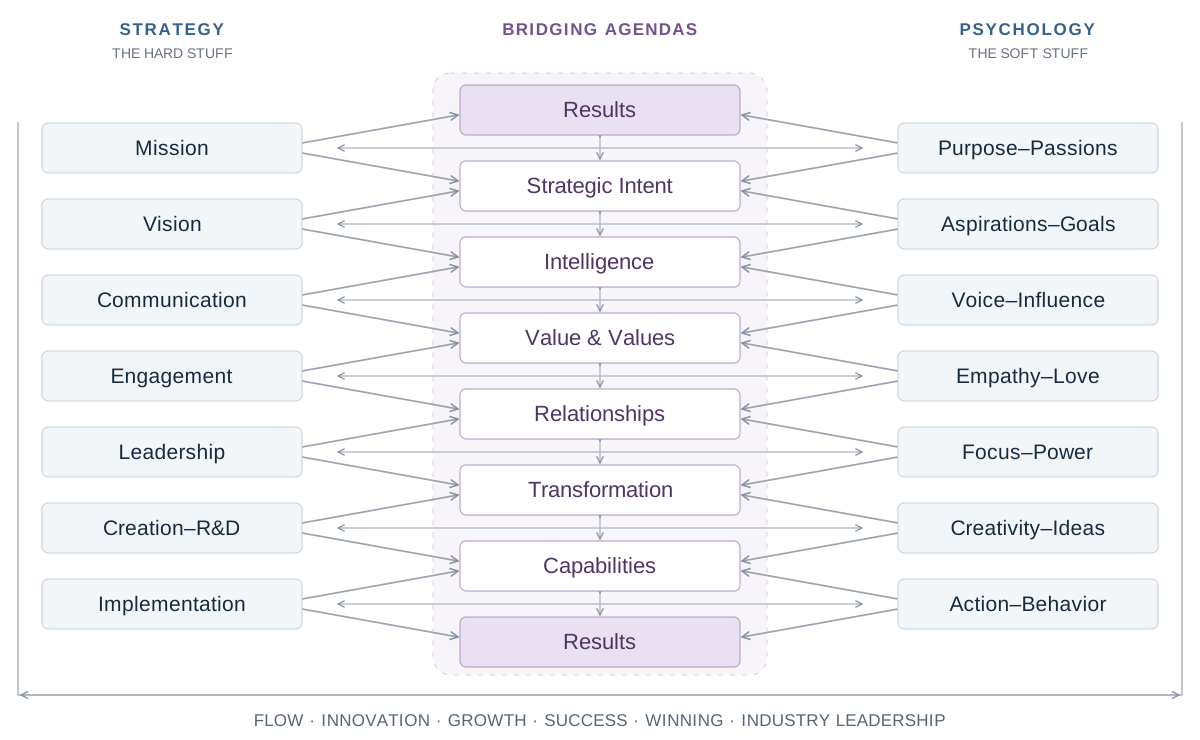
Seven connections. Select one to see its bridging agendas.
Bridging agendas: Results and Strategic Intent.
Bridging agendas: Strategic Intent and Intelligence.
Bridging agendas: Intelligence and Value & Values.
Bridging agendas: Value & Values and Relationships.
Bridging agendas: Relationships and Transformation.
Bridging agendas: Transformation and Capabilities.
Bridging agendas: Capabilities and Results.
The hard stuff: mission, vision, communication, engagement, leadership, creation and implementation.
Results, strategic intent, intelligence, value and values, relationships, transformation and capabilities connect the system.
The soft stuff: purpose, aspirations, voice, empathy, focus, creativity and action—the human nature within the organization.
Choose a short animation to see a different part of the thinking. Each includes a reading guide and a question to bring back to your team.
FIVE SHORT ANIMATIONS
Original animations by Dr Dave Richards.
Select a topic, then press play.
01 / THE WHOLE SYSTEM
See how the strategic elements and their human counterparts connect through Dave’s bridging agendas.
Where does your strategy need a stronger connection with people?
The animation follows the connections in the diagram above. Strategy and psychology both contribute to the central bridging agendas.
Mission and purpose connect through results and strategic intent. Vision and aspirations connect through strategic intent and intelligence. Communication and voice connect through intelligence and value and values.
Engagement and empathy connect through value and values and relationships. Leadership and focus connect through relationships and transformation. Creation and creativity connect through transformation and capabilities. Implementation and action connect through capabilities and results.
Results appear at both ends because the relationships form a connected system.
02 / STRATEGY IS A PROCESS
Follow the path from purpose to implementation, then see how results feed back into the strategic choices.
What are your results telling you to revisit?
The sequence begins with purpose and mission, then moves through vision and goals, communication, engagement, leadership, creation and implementation.
Implementation includes monitoring, measuring and assessing results. Feedback then returns to the earlier elements, making strategy an iterative process.
03 / THE HUMAN CONNECTION
The seven strategic elements sit alongside purpose, aspirations, voice, empathy, focus, creativity and behavior.
What are you asking people to believe, commit to and do?
Dave pairs mission with purpose and passions; vision with aspirations and goals; communication with voice and influence; and engagement with empathy and love.
Leadership connects with focus and power, creation with creativity and ideas, and implementation with action and behavior. The animation then introduces the bridging agendas that connect them.
04 / CREATING FLOW
A second view of the same relationship shows strategy and psychology working together throughout the organization.
Where could stronger alignment make work easier?
The animation places purpose, goals, voice, empathy, empowerment, creativity and behavior beside their strategic counterparts.
A moving connection joins the two columns. Dave uses the image of bridging DNA to express the relationship between human capabilities and strategy, with flow as the goal.
05 / WHEN PROGRESS GETS BLOCKED
Dave’s visual analogy explores why leaders need to look at the connections across the whole organization.
Which capability is limiting progress elsewhere?
The slide contrasts flow and blockage using images of the mind and human performance.
Its simple multiplication example shows seven factors at one producing one, then a zero factor reducing the product to zero. The numbers are a teaching illustration of interdependence.
For a leadership team, the useful question is where unclear purpose, weak communication, disengagement or another constraint may be affecting the rest of the system.
Explore the Seven Sins and the virtues that build innovation capability.
The work starts with your situation. Workshops, assessments and advisory conversations help you decide which capabilities deserve attention.
What are you trying to achieve—and how will you know you are making progress?
Look at the beliefs, motivations, relationships and everyday behaviors shaping the organization.
Identify where the connections need strengthening, then develop leadership, culture and working practices around those priorities.
“The most positive, focussed and creative management strategy session we have ever had”
Bring the ambition. Bring the friction. Let’s explore the leadership and cultural capabilities your next step depends on.